


1872: Kankakee Courthouse Burns
By Jack Klasey
October 4, 2025
At about 9:30 a.m. on Saturday, October 5, 1872, as the Circuit Court was closing out its September term on the second floor of the Kankakee County Courthouse, the smell of smoke was detected in the courtroom. At almost the same time, someone outside the building saw smoke curling up from the roof near the building's cupola, and raised the alarm.
In its October 10 edition, the Kankakee Gazette reported the destruction of the building beneath the headline, “Court House Burned” (it was, of course, “old news” to many Gazette readers, since the weekly newspaper was published on Thursdays). The Gazette related that, once the blaze was discovered, “as it soon became apparent that the fire would not be stopped, the work of removing the contents of the building actively commenced. All the books and papers in the vaults and in the various offices, together with the furniture in the lower rooms, and the household property of the jailer, Sheriff Durfee, were safely removed, and then nothing was left but to witness the destruction of the building.”
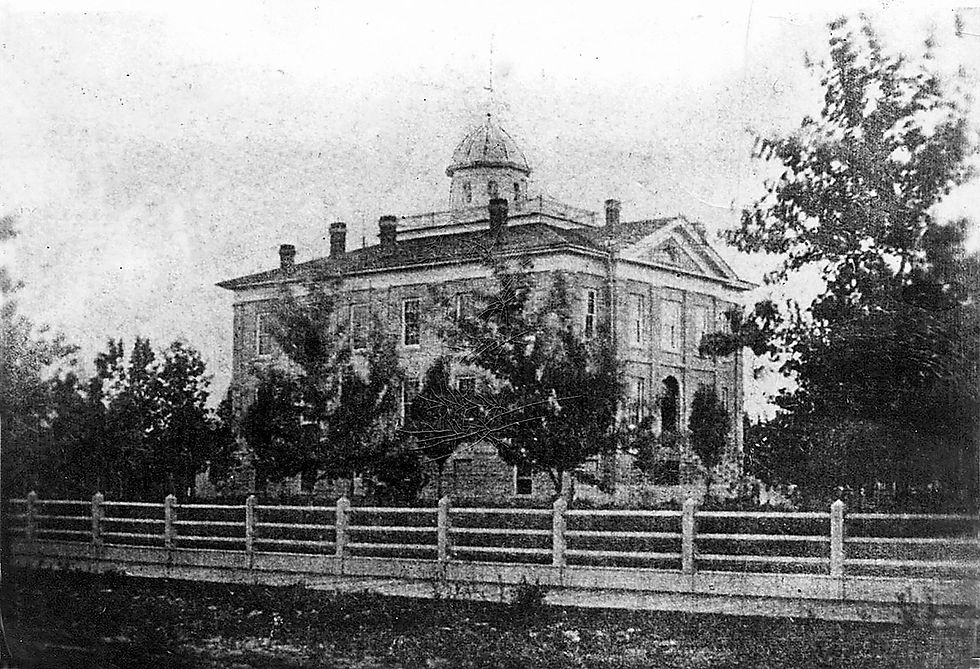
Located in the center of the “courthouse square” bounded by Court Street, Indiana Avenue, Merchant Street, and Harrison Avenue, the building was a sturdy stone-walled structure topped by a wooden cupola. Designed by Chicago architect W.W. Boyington and built in 1855, the courthouse had three levels: a tall basement housing the six-cell county jail and the Sheriff's living quarters; a first floor devoted to offices of the county's elected officials, and a second-floor courtroom.
Noting that “For a long time the fire was progressing slowly between the roof and the upper ceiling,” the Gazette raised the question of whether “adequate means of extinguishment would have saved the building, with perhaps the loss of the roof.” In 1872, Kankakee had no organized fire department, relying instead on volunteer “bucket brigades” to fight fires.
Adding to the problem was the fact that the fire originated in the roof of the building. “Not even a ladder which would reach the roof was obtainable,” the newspaper observed, “and hundreds of men who would have been willing helpers were compelled to be idle spectators after the valuable contents of the building had been removed.”
The Gazette called for action: “How long this shameful neglect of an obvious duty is to continue, we cannot say; but surely, it is high time that something should be done to protect the property in our midst.” Unfortunately, “something” would not be done until 1887, when the city’s first trained, organized volunteer fire companies were formed; a full-time, paid fire department would not be established until 1910.
Although the cause of the fire was never determined, early speculation raised two possibilities: a defective chimney, or arson. A man who had been released from the county jail the evening before the fire, Charles Beauman, was arrested on suspicion of setting the blaze. “A long examination … before justices Coflin and Stiles failed to elicit any proof against him, and he was discharged,” said the Gazette.
When the fire had burned itself out, only the building’s stone walls remained. The surrounding courthouse grounds were thickly wooded, and suffered severe damage—some 50 trees were victims of the flames.
Fortunately, the building had been heavily insured, and the County Board of Supervisors acted quickly to recover from the disaster. On Tuesday, October 8, the board established three committees: one to settle with the insurance companies, one to find temporary quarters for county offices, and one to “receive propositions for a new court house from other towns in the county.”
That third committee apparently received only one proposal to relocate the courthouse. “A proposition was received from Aroma to build and donate a court house and furnish water to put out fires,” reported the Gazette. Aroma also offered to donate the $30,000 in insurance proceeds back to the County Treasurer. That proposition was not accepted, since the courthouse would eventually be rebuilt on its original site.
Observing that “The business of the county suffered little or no interruption,” the Gazette listed the temporary locations of county offices: the county and circuit clerks, the treasurer, school superintendent, and county surveyor would all be housed in “Swannell’s one-story brick block on Court Street.” The county judge and county attorney would have offices in “Sibley’s Block,” and space in the Kankakee City Hall would serve as a courtroom.
Negotiations with the insurance companies were heated: the insurers offered a cash settlement of $15,000, while the county demanded that the companies either pay the full face amount of the policies ($30,000) or rebuild the courthouse themselves.
The insurance companies opted to rebuild the structure. Since the stone walls were still standing, the new courthouse was ready for occupancy in October, 1873, only one year after the fire. Kankakee County’s new (second) courthouse looked almost identical to its predecessor. The only noticeable differences were atop the structure: the cupola of the new building was taller and narrower, and a railed platform that surrounded the cupola of the original courthouse had been eliminated.
The rebuilt structure served the county for 36 years; it was demolished in 1909 to make way for the present (third) Kankakee County Courthouse. The current building, which opened in 1912, has served the county for 109 years.
Jack Klasey is a former Journal reporter and a retired publishing executive. He can be contacted at jwklasey@comcast.net.


Fascinating history. My husband's great-grandfather lost his life in 1910 during the rebuild. The Stilwell Company of LaFayette, Indiana was contracted to build it and he came up from Louisville to help with the work.